Tuesday, July 23, 2013

Arguments, Broadly Discussed Part II: Thoughts

The last post defined an argument and discussed how any speech act is also an argument. This post builds on that last one by addressing our thoughts.

Thoughts
So, are my thoughts arguments? We defined an argument as follows:

An argument is an assertion based on reasons. It is when a person asserts something and provides supporting evidence for that assertion.

At first glance, asking whether my thoughts are arguments sounds like a really weird question. After all, if they are, then who am I arguing to? Isocrates, a guy who set up a school to rival Plato's way back in the day, seemed to believe that thoughts were arguments and that the person we're arguing to is implied--it's ourselves. Isocrates wrote,
the same arguments which we use in persuading others when we speak in public, we employ also when we deliberate in our own thoughts; and, while we call eloquent those who are able to speak before a crowd, we regard as sage those who most skillfully debate their problems in their own minds. (Antidosis 329)
Yep, there he is. Isocrates.
In other words, we debate within ourselves whenever we have a decision to make, and the same kinds arguments that we make externally (to other people) are the same kinds of arguments that we make internally (to ourselves in our own minds). Why? Because what's on the outside is a reflection of what's on the inside, and the arguments we make to other people are the arguments that we are capable of making. I have especially in mind here the form of an argument, and not necessarily any one particular argument.

So, if the same kinds of arguments we make to others are the same kinds of arguments we make to ourselves in our own minds, then if our outward assertions are based on sound reasoning then it is likely that our inward ones are also based on sound reasoning.

For example, if I'm making fallacious arguments with other people, we can also assume that, when I debate things with myself in my own mind, I'm also making fallacious arguments. Since the kinds of people we are is determined by the kinds of decisions we make, there is a direct relationship between the arguments we make and the kind of people that we are.

This is why several Roman and Renaissance philosophers, rhetoricians, and scholars such as Cicero, Quintilian, Desidrius Erasmus, and Baldassare Castiglione would build on Isocrates' statement, arguing that it is impossible for the good speaker to not be a good person. Only good people could be good speakers.

But wait a minute. Only a good person can be a good speaker? What about Hitler? Wasn't he a good speaker? I mean, didn't he persuade a whole bunch of people to believe him? Perhaps, as philosopher Leo Strauss said, this reductio ad Hitlerum is irrelevant. But just for the sake of argument, let's see if our assertion can withstand it. If it can, I think we're on to something.

Hitler's Fallacies
In his Mein Kampf, Hitler makes arguments all over the place.2 What we want to do is see if these arguments are good arguments. Let's take a look.

In Chapter XI, "Nation and Race," he argues that the Aryan race ought to purify and isolate itself because other animals in nature do the same things: "The consequence of . . . racial purity, universally valid in Nature, is not only the sharp outward delimitation of the various races, but their uniform character in themselves." Well, there's a claim. What evidence does Hitler give his audience to accept it? Here it is:
The fox is always a fox, the goose a goose, the tiger a tiger, etc., and the difference can lie at most in the varying measure of force, strength, intelligence, dexterity, endurance, etc., of the individual specimens. But you will never find a fox who in his inner attitude might, for example, show humanitarian tendencies toward geese, as similarly there is no cat with a friendly inclination toward mice. (285)
Haha. He's just tried to pull a fast one on us: he's comparing different races to different animals and essentially using his metaphor to argue that just as a cat isn't nice to mice, the Aryan race shouldn't be nice to Jews. But Hitler's evidence and metaphor is fallacious. He is using what is called a false analogy, a fallacy meaning that two things are compared to each other but the two things have more differences than similarities, yet they are compared as if they had more similarities than differences! Bad evidence, Hitler!1

Hitler is making a faulty comparison. His reasoning is fallacious. And the same arguments, going back to Isocrates, that he makes to us are the same arguments that he makes to himself in his own mind. So, either he's lying to us or he really believes what he says and he's just trying to manipulate us. But whether he's lying or not, a fallacy is still a fallacy. More on this idea of lying below. First, let's look at one more example.

Hitler often takes a statement that almost anybody would agree with and twists it just a bit to make it untrue. Or, he talks about something that everybody will agree with for several pages and then, at the very end of the discussion, he'll tag on a small phrase that he didn't actually address or argue for in the previous several pages. For example, here is a statement that I think most people would agree with: he says, talking about the youth, "Parallel to the training of the body, a struggle against the poisoning of the soul must begin" (254). Most people would agree that youth and children shouldn't go to certain movies. That's why we have a rating system. Hitler is essentially saying the same thing. Next, Hitler goes on to smack down some of the immorality that had been going on in Germany at the time: he says we must
clear away the filth of the moral plague of big-city 'civilization' and [we] must do this ruthlessly and without wavering in the face of all the shouting and screaming that will naturally be let loose. If we do not lift the youth out of the morass of their present-day environment, they will drown in it. (254-255)
Hitler then continues to talk about the preservation of body and soul, and argues that cities ought to be cleaned up from prostitution and pornography because such an environment is not good for children and youth--again, he's writing about things that most people would agree with. We wouldn't take a 4-year old to see an R-rated movie. It just doesn't make sense.

But then Hitler tries to pull another fast one on us, a fast one which, if we're paying any attention to what he's actually saying, isn't all that fast. A page later, he says that "the sickening of the body is only the consequence of a sickening of the moral, social, and racial instincts" (256).

Unrelated, but amusing. See Note 3 for citation.
Haha. Very funny. Hitler has just spent 2 pages talking about moral and social problems and how they need to be solved, but where did "social and racial instincts" come from? Nowhere, that's where. Hitler just threw it on the end of the sentence without having provided any evidence for it. Tagged it on at the end of the sentence. So he's talking for 2 pages and people are nodding their heads at what he's saying, and he's hoping that he can just stick little things on the end of sentences like "social and racial instincts" and the people will just keep on nodding. Unfortunately, some people really did keep on nodding.

The same overarching principle was discussed by Kenneth Burke, rhetorician and philosopher, when he wrote,
we know that many purely formal patterns can readily awaken an attitude of collaborative expectancy in us. . . . Once you grasp the trend of the form, it invites participation regardless of the subject matter. Formally, you will find yourself swinging along . . . even though you may not agree with the proposition that is being presented in this form. Or it may even be an opponent's proposition which you resent--yet for the duration of the statement itself you might "help him out" to the extent of yielding to the formal development, surrendering to its symmetry as such. Of course, the more violent your original resistance to the proposition, the weaker will be your degree of "surrender" by "collaborating" with the form. But in cases where a decision is still to be reached, a yielding to the form prepares for assent to the matter identified with it. Thus, you are drawn to the form, not in your capacity as a partisan, but because of some "universal" appeal in it. And this attitude of assent may then be transferred to the matter which happens to be associated with the form. (A Rhetoric of Motives 58)
Here's an example Burke gives: "Who controls Berlin, controls Germany; who controls Germany controls Europe; who controls Europe controls the world" (58). He then says,
As a proposition, it may or may not be true. And even if it is true, unless people are thoroughly imperialistic, they may not want to control the world. But regardless of these doubts about it as a proposition, by the time you arrive at the second of its three stages, you feel how it is destined to develop--and on the level of purely formal assent you would collaborate to round out its symmetry by spontaneously willing its completion and perfection as an utterance. Add, now, the psychosis of nationalism, and assent on the formal level invites assent to the proposition as doctrine. (58-59)
A similar thing is going on here in this passage from Hitler. The audience already agrees with his discussion of cleaning up immorality because almost everybody agrees with not exposing young children to immorality. So, when he says the sickening of the moral instincts are problematic, they're already nodding their heads. But when Hitler tags on social and racial instincts while the audience is already nodding, it's hard for them to stop the head from going up and down because they've been doing it for the last 2 pages and are already passionate about what he's been saying. It's hard, when we agree so wholeheartedly about one thing that a speaker says, to stop agreeing when something we completely disagree is brought to the fore, especially if we're passionate about what the speaker has just told us before he's tagged something else on. What we try to do instead is figure out why what was said was said. It's actually harder for our brains to rewire themselves, so we try to justify our beliefs and the nodding of our heads.4

So where are we?
We are showing that Hitler's book is full of fallacies because his fallacies are evidence of his not being a good speaker. But, since the same kinds of arguments we make to others are also the same kinds of arguments that we make to ourselves in our own mind, since Hitler's arguments to us are bad, we also assume that his arguments to himself are bad. Meaning that Hitler is not a good person because his arguments are not good.

Fallacies are what Hitler is capable of. He's trained himself to think fallaciously. What this means is he's also making fallacies in his own mind, so the choices he makes are also "fallacious."

The counter-argument could be that Hitler doesn't really doesn't believe what he's saying--meaning he could be lying to us just to get us to follow him. But this counter-argument misses the whole point. Because even if Hitler is lying to us we still must classify him as a liar, which, by definition, is also a bad person.

But what if he doesn't know better? What if Hitler is using these fallacies on accident? One of my teachers, Nancy Christiansen, once taught me that to use fallacies on purpose makes a person evil, and to use them on accident makes a person a fool. But either an evil person or a foolish person isn't the kind of person we want to follow. It's not a good person.

Quintillian, a Roman rhetorician and educator, wrote that "[T]he mind cannot be in a condition for pursuing the most noble of studies unless it be entirely free from vice" (Institutio Oratorio 12.1.3). I don't know what is or was in Hitler's mind. I can't read his thoughts. But I don't need to know what was in his mind to know that he was not a good person. His actions tell me that.

Thoughts are arguments. And arguments are action. The next post will address actions.

Notes
1. The fallacy also borders on (and could be seen as a derivation from) a hasty generalization.

2. By discussing Hitler's Mein Kampf, I am not recommending that the reader go out and read Hitler. If you need something to read, read Aristotle. I am not advocating hate literature. I am only showing that there is something psychologically, logically, and morally wrong with the logic of hatred. See also this post.

3. http://img24.imageshack.us/img24/2513/scissorsbeatspaper.jpg

4. Robert Cialdini discusses this in his book, Influence: Science and Practice.

Wednesday, July 17, 2013

Arguments, Broadly Discussed Part I: Speech

An argument is an assertion based on reasons. It is when a speaker asserts a belief in and provides supporting evidence b, c, d, etc. for that assertion.

From this perspective, we argue with one another all the time--we say things and we back up what we have said with evidence. Teachers assert to students and give evidence for their assertions; lawyers assert and back those assertions up with evidence. It happens all over the place.

Let me be clear. By argue and arguing I do not mean that two (or more) people are yelling at one another at the top of their lungs. That is not (necessarily) an argument. An argument is not about bickering or fighting. It is about asserting something and backing that something up with reasons, and I do not write about the word as if it had a negative connotation.

I'm suddenly reminded of this video:


Okay. But so what?

Well, I think there's something deeper going on here that we don't always notice. And this something deeper is important to understand because it will help explain many of the nuances in the world around us. When we see this something deeper, we'll start to see arguments--assertions--all over the place, which, beside the fact that it's really cool, will help us understand who we are as human beings, how and why we understand and misunderstand one another, and why we do the things we do.

This post is the first of a 4-part series about the usefulness of broadly defining arguments to include things such as speech, thought, and action (and perhaps even objects?--I'm still figuring out this last one). This particular post will discuss arguments in terms of speech. So let's check it out.

Speech
An argument is an assertion or belief that is supported by evidence. So, even everyday statements like, "I appreciated what she said to me because it made me feel happy," or "May I please cut in front of you because I am in a hurry?" are arguments.

So, the statement, "I appreciated what she said to me because it made me feel happy" asserts that the speaker "appreciated what she said to me," and the reason for that assertion was whatever was said "made me feel happy." Okay.

We could also talk speech in commercials and how the people who write commercials try to persuade us to buy their product. They give us reasons why we should buy the product, such as this product will make you popular, it will make your life easier, or it will taste good. We could go on, but let's stop and talk about something more interesting and less obvious. Let's talk about statements that don't seem like arguments but that actually are arguments.

So what about the statement, "It made me happy"? Is that an argument? Are assertions (and hence arguments) nested and recursive? 

If they are, then the reasons that we use to back up our assertions are actually assertions with reasons behind them. And those reasons are further assertions, etc. Just for fun, let's assume that reasons are also assertions and see what we come up with.

So, in the above example, the reason, which is whatever was said "made me feel happy," is also an argument. This assertion's assertion is that something was said to make me feel happy. But what is the reason of the assertion's assertion? This is where things get interesting: the reason is not stated, but it still exists--in the mind of the speaker.

So what might be the reason? Or are we assuming too much in that last sentence by using the word the and the singular form of the word reason? In other words, there might be multiple reasons behind a single assertion. Some of those reasons are stated, while others exist unstated in the mind of the speaker.

But how on earth can an unstated reason actually be a reason for a stated assertion? Well, we can start from the fact that the words were spoken by someone in the first place. In other words, why do we even say anything?

The things we say reflect our individual capacity to choose: I say things in a certain way because I choose to speak, I choose to speak about something, and I choose how I will say what I want to say. Furthermore: we say things because we want to. The things we say and the way we say them are a reflection of our desires, appetites, attitudes, and emotions. The things we say are a reflection of states that we feel in our bodies.

So, going back to the above example, by asserting that something someone else said made me happy, I'm also asserting several of my own unstated beliefs.

I assert my belief
1. that it is desirable to speak about things that make me happy. 
2. that it is, in this case, a desirable thing to share information (especially positive information) with other people.
3. in being loyal to my hearers and sharing personal information with them.
In fact, depending on the context, the subject about which I'm speaking, my own emotional state of mind, who my audience is, and what that audience desires, there could be a whole bunch of other things we could have listed that will influence my assertions and my reasons--in short, my arguments. There's a lot going on when we say something. And we're usually not paying attention to everything that's going on.

So where are we?
1. An argument is an assertion with attached reasons, and we make arguments when we speak.
2. Our reasons behind our assertions are also themselves assertions with reasons.
Next step: I'd go so far as to say that we're always making arguments when we speak. Not only that, but our assertions (arguments) are so nuanced that we make multiple arguments and assertions whenever we speak and at the same time.

My grounds for that assertion come from my earlier-stated belief that the things we say and how we say them reflect our own capacity to choose. When I speak I make judgments about what is good and not good, and I try to the best of my ability to choose what is good--hopefully to choose what is better over what is good and what is best over what is better. I don't always choose the best or the better or even perhaps the good, but I try. And the more I try the better I get at it.

Let's look at another example, an example that would not seem like an argument because it is such a casual occurrence, but an example that nevertheless reveals a speaker's judgments.

Let's say I'm passing you on the sidewalk and I say, "Good morning." Is this statement an argument? It seems like it isn't, but from what we've discussed above, I believe that it is. So how do I back up that claim? What assertions does a simple, "Good morning," make?

Obviously, by saying, "Good morning," I am asserting that the morning is good. But what about the reasons? Do I as a speaker have evidence to back up my claim? Does my assertion that the morning is good have reasons? These reasons are certainly unstated, but they do exist--in my own mind, for I would not have said, "Good morning" if I did not have reasons for thinking that it indeed was a good morning.

So perhaps to me it is a good morning. Maybe I had sausage and an omelet for breakfast and washed it down with some orange juice, and maybe I hit all the green lights on the way to work. I have reasons to back up my claim, and I desire to share my good morning with other people by wishing someone I have not met a good morning.

I am also asserting that I am the kind of person that says, "Good morning" to a person he passes on the sidewalk. Some people don't say anything, some only make eye contact and nod, and others avoid eye contact altogether. Not only that, but saying, "Good morning," asserts that I am the kind of person that says, "Good morning," in this particular situation instead of any of the other things I could have said, or not said: instead of "Good morning," I could have said, "Hello," "Greetings," or "Wassup?" My act of choosing to say one thing over something else asserts that I am the kind of person who has chosen one thing over other things in this particular situation. My choice is an assertion, and my assertion is backed up by reasons.

But enough of speech. Let's move on to thoughts.

[Thoughts will be discussed in the next post.]

Notes
1. Sometimes, such as in logic and philosophy, an argument is defined as a form of persuasion based on reasons. Since an assertion based on reasons is also a form of persuasion, "a form of persuasion based on reasons" contains in germ the phrase "an assertion based on reasons." I only discuss an argument as an assertion based on reasons instead of as a form of persuasion based on reasons in this post.

Thursday, June 20, 2013

Analysis of and Annotations on an Email I Just Received from The White House

Before we get to the good stuff, let me make one thing clear: I am not agreeing nor disagreeing with what the author below says, and my act of discussing the following email is not meant to promote nor contradict what it says.

All I want to do is reveal what is going in here through language. Both sides (dare I say "all people"?) use strategies such as the ones I'm discussing, so here we go. First the email, then my commentary.


Now it's time for some commentary. I'm going to talk about what the author(s?) are going to do to their audience through language. Let's look at the first bit:


The White House, Washington
Hi, all!
This week, we got some big news about the immigration reform bill. It's a little wonky, but it's so great that I couldn't wait to share it with you.
"Hi, all!"
First of all, the logo at the top gives the email an official and professional feel, yet the casual opening—with the brief and friendly “Hi,” “all,” and perhaps especially the exclamation point—invites the audience to feel at ease and get excited about what will follow. Excitement is contagious, as long as it’s not over the top, and I assume here that by expressing excitement the authors want readers to feel excitement. The authors seem sincere in that they really believe what follows, and who wouldn’t be excited after finding out the facts that follow? This excitement is all over the email and is manifest at the end of the first paragraph with, "it's so great that I couldn't wait to share it with you."

"a little wonky"
Honestly, I had to look the word wonky, but the word does add to the casual feel of the email. As citizens, we like things to be on our level, and politics is often so highly technical that we don’t understand it. By using casual speech and word choice to speak on the same level as readers, authors help readers make the assumption that authors and readers really are on the same level socially, intellectually, etc.

Also, “a little wonky” helps address concerns that audience members might already have about the issue. The phrase “a little wonky” is saying, when read in the context of the entire email, “Sure, the bill isn’t perfect—nothing is—but its merits outweigh its defects.” 

Now let's check out the next paragraph:
The nonpartisan experts who estimate the financial impact of legislation for Congress concluded that because undocumented immigrants will start paying more in taxes for things like education and Social Security, the immigration proposal in the Senate will make the economy fairer for middle class families while cutting the U.S. deficit by almost $1,000,000,000,000 over the next two decades.
"nonpartisan experts"
These are not just “experts,” but “nonpartisan experts.” This is a carefully chosen phrase. We like things to be nonpartisan because we like things to be unbiased. We are more likely to trust the authors when they tell us that they are using “nonpartisan” (read "unbiased") sources. Is "nonpartisan" equivalent with unbiased, however? I don't know. I don't think we have enough information here to answer that question. But it's easy to think they mean the same thing in this context.

"undocumented immigrants"
Note the careful word choice here, too: these are not “illegal” but “undocumented” immigrants. “Illegal” is a negative term, and the authors of this email want to stay positive.

"for things like"
Here we have some simple yet somewhat vague language: “things like” tells us that things are being simplified into terms that we can understand, but there are also things that are unlisted. There is more going on here than we know, but it’s also being translated. If we trust the authors we trust their translation, and if we like the casual and optimistic tone, we may not even question word choices such as this one.

"almost $1,000,000,000,000"
Spelling out the trillion is strategic: to see that many zeros on a page is impressive. It’s not every day that we see a number that big. “1,000,000,000,000” is physically longer (it takes more space on the page) than “a trillion.” Spelling the word out makes the concept seem bigger than if we just had “one trillion.” According to The White House's Google+ page, the number is closer 897,000,000,000. 

Finally, let's take a minute to check out the last two paragraphs:
With every passing day, it’s becoming clear that we can’t afford not to act. Now we know exactly how much is at stake, and it's the kind of news that can help to change the policy conversation in Washington.
So we've put together a graphic that explains exactly how this works, and we need your help to share it. If more people get the facts, it'll be easier to build a nationwide, bipartisan consensus to get this done.
"we know exactly"
This “we” is especially nuanced. Since above we’re told “almost $1,000,000,000,000,”  and since we’re also given simplified examples such as “things like,” as discussed above, can “we” really say that “we know exactly how much is at stake”? This particular “we” does not seem to include readers of the email but only the authors of the email, the “nonpartisan experts”--unless, of course, the readers of the document already trust and have sided with the authors. Then "we" really do "know exactly how much is at stake." Trust, as Aristotle once said, is the strongest rhetorical appeal. We believe those we trust. Trust is always an issue. Cf. Kenneth Burke's "Responsibilities of National Greatness" for more commentary and discussions about the identifications concerning the word we.

"the facts"

An ultimate term. See this and also this. The assumption here is that the things which the authors have shown readers in this email are the facts.

"bipartisan consensus"

Also an ultimate term. Most of us are sick of the fighting between parties. We want a “bipartisan consensus,” which is the political ideal. We do strive for agreement, and nothing gets done without it. The assumption here is that if we accept, agree with, and share the information contained in this email, we will begin to be less frustrated with partisan politics. 

Thanks for reading. Again, I'm not arguing for or arguing against the content of this email. I'm just discussing what the authors leave implicit.

Wednesday, June 19, 2013

A Farmer and His Chickens, by Kenneth Burke

Once upon a time there was a farmer who had some chickens. Whenever he poured food into the chicken troughs, he would ring a bell and the chickens, hearing it, would come running. At the sound of the bell, the chickens knew it was time to eat, and they were hungry.

Months passed, and it eventually came time for the farmer and his family to eat the chickens. The farmer grabbed his gun and his ax and went out to the chicken coop. He also brought with him the bell. When the farmer got to the chicken coop he loaded his gun and rang the bell. Then the chickens came running.

The chickens were trained to believe that it was time to eat when the bell rang. But when the situation changed, they did not understand that the bell no longer signified that they would receive food--on the contrary, it now signified that they would become food. The chickens had been trained in a way that made them incapable to see things from another perspective.

So the chickens were killed, and the farmer and his family ate.


(This post is a retelling of an idea from Kenneth Burke's Permanence and Change 7-10.)

Wednesday, June 12, 2013

Ruminations on E.T.

Yes, I know you've seen it, but it's probably been a while. It was the same for me when I'd watched it a few weeks ago. It had been a while.
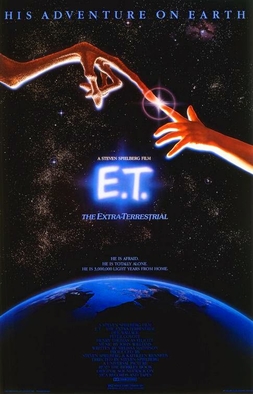
Original poster found on Wikipedia

You remember it: E.T. gets stranded on earth, is found by a ten-year-old kid, Elliott, who befriends him. For a while, Elliott is the only one who knows about and can see E.T. And while he tries to tell others about E.T., they disbelieve him and are angry with him for making up worthless stories. Eventually, however, his siblings and some other kids start seeing E.T., too. The adults, on the other hand, have a hard time seeing him, either because the kids are trying to hide him from the adults or because the adults are so preoccupied that they don't see the signs that he is there. Sometimes, the adults don't even see E.T. when he is right in front of them, like the scene when Elliott's mother opens Elliott's closet and sees E.T., but mistakes him for a toy since E.T. has frozen in place. Indeed, the boys even say at one point that adults can't see E.T. E.T., however, wants nothing more than to go home.

Eventually, E.T. becomes ill. It's not exactly clear what makes him ill. Sure, he may have caught a cold by staying up all night trying to contact his alien family. Or maybe the Earth food had a negative effect on his immune system. He may also have become physically sick because he was mentally homesick. But this last time I watched it, I wondered about something else. Could it be that E.T. symbolizes an idea and, when that idea gets tampered with, dies? Could we say here that, in Wordsworth's words, "Our meddling intellect / Mis-shapes the beauteous forms of things:-- / We murder to dissect"?

Eventually, E.T. is discovered by adults, and they start trying to help him, to cure him, of his sickness. But could it be that we're not seeing everything here? Could they also be doing tests on him and otherwise messing around with this new creature that they had never before seen and never would see again? For who can withstand the curious inclination to discover and behold something that no other earthling had ever seen before?

Perhaps it's a long stretch. But whatever happens, E.T.'s body can't handle it, either the sickness, the tests, or both. Perhaps in their trying to help E.T., the doctors actually hurt him. At least, that's what Elliott believes and even screams at one point.

Are there some things that die when they get tampered with? I'm suddenly reminded of two things.

C. S. Lewis, in his first-published Narnia book The Lion the Witch and the Wardrobe, dedicates the book to his goddaughter Lucy Barfield with the following statement:
My Dear Lucy,
I wrote this story for you, but when I began it I had not realized that girls grow quicker than books. As a result you are already too old for fairy tales, and by the time it is printed and bound you will be older still. But some day you will be old enough to start reading fairy tales again. You can then take it down from some upper shelf, dust it, and tell me what you think of it. I shall probably be too deaf to hear, and too old to understand a word you say, but I shall still be
your affectionate Godfather, 
C. S. Lewis
What does Lewis mean when he says that "some day you will be old enough to start reading fairy tales again"? Do we get to a point in our lives where we begin to take for granted some of the best things? Best things? What am I saying? J.R.R. Tolkien has written that fairy tales, or fantasy, is "not a lower but a higher form of Art, indeed the most nearly pure form, and so (when achieved) the most potent" ("On Fairy Stories," The Monsters and the Critics and Other Essays 139). That may sound like quite a surprising statement from an Oxford don and Cambridge professor, a world-renowned philologist and scholar of Anglo Saxon. Why would he say such a thing?

Does this mean that all fairy tales are worth while? Certainly not. For while some stories shouldn't be read at all because they aren't worth our time, "If fairy-story as a kind is worth reading at all it is worthy to be written for and read by adults." ("On Fairy Stories" 137).

Yes, E.T. comes back to life when Elliott says through tears that he loves E.T. But after that, both E.T. and Elliott are on the run. The kids are the ones that save E.T. from capture the second time, and the kids are the ones that take him back to the forest where his ship comes to rescue him. The adults, except for Elliott's mother, don't see him up close after that.

Monday, June 3, 2013

Communicating without Words?

Last week, two of my favorite people were married to one another. Here's what the 3 of us looked like at one point:


About halfway through the reception, Ryan and Ju left for a minute. They returned, having changed into traditional Korean wedding robes. Awesome.

Two chairs were then brought in, and Grandpa and Grandma sat down. Ryan stood in front of Grandpa and Ju in front of Grandma. And then, in unison, Ryan and Ju knelt down in front of Grandpa and Grandma and bowed to them three times. The four of them then stood and embraced one another.

Then Mom and Dad sat in the chairs.


Again, Ryan and Ju knelt down and bowed their heads to the floor. They stood, and so did Mom and Dad. Then all four embraced.

Finally, Ju's mother sat in a chair and her uncle sat in the other chair (on this occasion, her uncle took the place of her father). Again, Ju and Ryan knelt and then bowed. And at the same time Ryan and Ju were bowing, Ju's mother and uncle bowed their heads. All 4 bowed in unison. Then all arose and embraced.

Ryan then presented Ju's mother with a gift bag. In Korea, if the mother of the bride receives a wooden goose from the groom's family it means that her daughter will be well-taken care of. Well, Ryan handed Ju's mother a gift bag, and she opened it. Inside was a wooden goose that our mother had painted.

I can't describe the expression on Ju's mom's face. It was one of gratitude, surprise, and joy, and when she saw it she let out an audible gasp. She began to weep, and Mom ran over and embraced her.

Several people that were watching were a bit confused because they didn't understand the symbolism of the gift. But all who watched understood that there was something being communicated between two families that did not speak the same languages.

Human beings can only communicate insofar as a margin of overlap exists between person A's experiences and person B's experiences. But that margin of overlap always exists, even if we do not speak the same language, because we are all human beings. We are all embodied spirits. It seems to me that, no matter where a person is from, tears are universal. Love is universal.

We're all human beings here. And we don't have to completely understand one another in order to treat one another with kindness, respect, and love. Our traditions, though they are different, are good. And human beings have an innate capacity for love and kindness.


Thursday, April 11, 2013

Considering Sources of Knowledge as We Near the End of Another Semester

Before we began the current semester just a few months ago, we may have heard or felt a subtle voice that called us by name, saying,
Where are your books?--that light bequeathed
To Beings else forlorn and blind!
Up! up! and drink the spirit breathed
From dead men to their kind.

You look round on your Mother Earth,
As if she for no purpose bore you;
As if you were her first-born birth,
And none had lived before you! (William Wordsworth, "Expostulation and Reply")
Had we not heard this voice, at least in some form and to some degree, we probably would not have began our studies this semester.


And yet, now that we're nearing the end of it, some of us may hear yet another voice, one that is now telling us the exact opposite:
Up! up! my Friend and quit your books;
Or surely you'll grow double:
Up! up! my Friend and clear your looks;
Why all this toil and trouble?

Books! 'tis a dull and endless strife:
Come, hear the woodland linnet,
How sweet his music! on my life,
There's more of wisdom in it. (William Wordsworth, "The Tables Turned")
We hear this voice as finals week approaches and, especially when we look outside and see the beginnings of a warm and bright spring day, are almost compelled to agree: "An 'endless strife' indeed!"

But the purpose of the above poem, as I understand it at least, is not to denounce books or to say that there is no value in learning. It is, on the other hand, to say that there are more and perhaps better sources of knowledge and learning than that which comes out of books alone. The poet continues:
And Hark! how blithe the throstle sings!
He, too, is no mean preacher:
Come forth into the light of things,
Let Nature be your teacher.
. . .
One impulse from a vernal wood
May teach you more of man,
Of moral evil and of good,
Than all the sages can.

Sweet is the lore which Nature brings;
Our meddling intellect
Mis-shapes the beauteous forms of things:--
We murder to dissect.

Enough of Science and of Art;
Close up those barren leaves;
Come forth, and bring with you a heart
That watches and receives. (William Wordsworth, "The Tables Turned")
Enough--that's what's on our minds as we contrast sitting in a room and taking a test or writing a paper with what happens on the other side of the window: white clouds, blue sky, and warm sun. When we consider this contrast, perhaps our thoughts flow to this question that was implicitly asked in the first poem: Why do I do the things I do? Why do we read and study so much?

Here's another related poem by Walt Whitman on the same subject. He writes about charts and diagrams the same way Wordsworth discusses books in the above poem. Here it is:
When I heard the learn'd astronomer;
When the proofs, the figures, were ranged in columns before me;
When I was shown the charts and the diagrams, to add, divide, and measure them;
When I, sitting, heard the stronomer, where he lectured with much applause in the lecture-room,
How soon, unaccountable, I became tired and sick;
Till rising and gliding out, I wander'd off by myself,
In the mystical moist night-air, and from time to time,
Look'd up in perfect silence at the stars.
Knowledge can come from books and lectures and charts. But these are not the only sources of knowledge.

In the above poem, we don't get to the stars until the very end--the last word, even. In other words, we don't symbolically ascend until we've physically left the lecture hall and actually turned our gaze upward. A focus on one thing involves to some degree a neglect of something else (cf. Burke Permanence and Change 49), and if a gaze is looking at "charts and diagrams"--or words on a page or a computer screen--it is conversely not seeing stars in "perfect silence" and "mystical moist night-air."

That isn't to say that something might not be learned by seeing these "charts and diagrams" or words on a page or a screen. Quite the contrary. But when we sit in a lecture hall and look at charts and diagrams, we're only seeing a symbolic representation of the stars. The stars are not actually seen with the eye. They are only "seen" symbolically with the mind (Cf. Lakoff and Johnson, Metaphors We Live By).

Charts and diagrams--books--should ultimately lead people to study things as they really are--dare I use the word truth here? Yes, I think so. I believe that truth is things as they really are. There may, of course be some value in studying books and charts for their own sake--it it is important to look at a lens from time to time in order to make sure that the lens is a pure instrument for letting us see through it.

The Chinese philosopher Zhuangzi put it this way:
Men of the world who value the Way all turn to books. But books are nothing more than words. Words have value; what is of value in words is meaning. Meaning has something it is pursuing, but the thing that it is pursuing cannot be put into words and handed down. (Complete Works of Chuang Tzu, trans. Watson 1968, 152)
In more religious discourse, Joseph Smith expresses the same idea as Wordsworth, Whitman, and Zhuang:
Reading the experience of others, or the revelation given to them, can never give us a comprehensive view of our condition and true relationship to God. Knowledge of these things can only be obtained by experience through the ordinances of God set forth for that purpose. Could you gaze into heaven five minutes, you would know more than you would by reading all that ever was written on the subject.
Yes, books are certainly valuable. But there's more to learning than just seeing words on a page.

Book Review: The Rhetoric of American Civil Religion

I've recently received word from Taylor & Frances Online that a book review I wrote was published in the Journal of Religious and Th...